

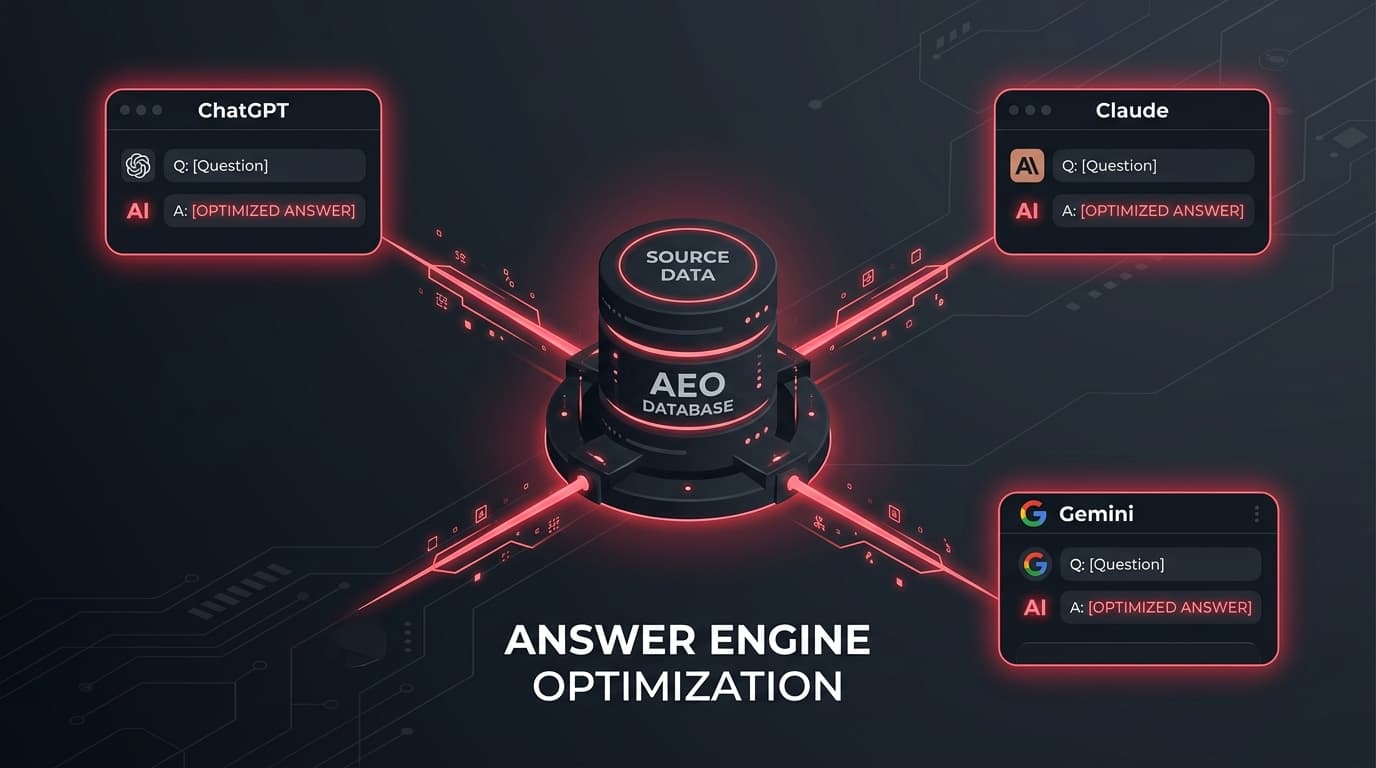
The digital search landscape is undergoing a tectonic shift. In 2026, search is no longer defined solely by blue links on a page. The rise of conversational models like OpenAI's SearchGPT, Anthropic's Claude, and Google's Gemini has ushered in the era of Answer Engine Optimization (AEO). Users are increasingly turning to Large Language Models (LLMs) to retrieve structured summaries, compare products, and solve problems directly. If your business is not cited as a source inside these generated responses, you are virtually invisible to a massive and rapidly growing segment of search traffic.
Traditional SEO focuses on keywords, backlink counts, and metadata tags to satisfy algorithmic indexers. AEO, by contrast, targets the retrieval mechanisms of Retrieval-Augmented Generation (RAG) models. To win in this new paradigm, your content must be structured to be easily parsed, verified, and cited by LLM agents. In this blueprint, we break down the mechanics of AEO and provide actionable frameworks to maximize your brand's AI search footprint.
How Answer Engines Retrieve Information
To optimize for LLMs, you must first understand how they gather data. Unlike traditional crawlers that index text files for keyword matching, LLM scraper agents utilize advanced vector databases and semantic indexing. The retrieval process generally follows a three-step cycle:
- Intent Analysis: The system deciphers the user's conversational prompt, identifying core entities, conditions, and requested outputs.
- Vector Retrieval (RAG): The engine searches its indexed database of the web, retrieving snippets that match the query's mathematical vector space (semantic similarity).
- Synthesis and Attribution: The model synthesizes the snippets into a cohesive natural language response, placing citation markers pointing back to the source URLs.
If your domain lacks clear authority signals, or if your content is buried in complex layouts, the retriever will skip your page in favor of structured, easily readable formats. For high-authority technical foundations, our Technical SEO Consultancy aligns server architecture with AI crawler requirements, ensuring zero indexing friction.
AEO Comparison Matrix across Platforms
Each answer engine prioritizes different signals when pulling sources. The table below outlines how ChatGPT, Claude, and Gemini weigh content attributes for citation selection.
| Engine | Primary Retrieval Signal | Key Citation Format | Update Frequency |
|---|---|---|---|
| OpenAI Search | Brand mentions & direct entity associations | Numbered footnotes and inline hyperlink cards | Real-time API integrations |
| Anthropic Claude | Logical hierarchies and technical whitepapers | Context-rich parenthetical references | Periodic knowledge graph refreshes |
| Google Gemini | Structured Schema Markup & Google Maps API | Interactive cards and vertical link columns | Continuous indexing from Google search crawl |
The 4 Pillars of AEO Success
To optimize your domain for answer engine selection, you must build your strategy around four core pillars:
1. Semantic Query Targeting (Q&A Formatting)
Conversational search queries are longer and more question-focused than keyword searches. Instead of targeting "SEO audit tools," format your content to answer: "How do I run a free enterprise technical SEO audit?". State the question clearly in an `H3` heading, and follow it immediately with a concise, direct answer in the first 2-3 sentences. This provides a clean "hook" for LLMs to extract and cite.
2. Structured Data and Entity Mapping
Provide search engines with structured context via Schema markup. By referencing JSON-LD models such as `TechArticle`, `Product`, and `FAQPage`, you remove semantic ambiguity. This allows LLMs to understand exactly what your page is about, what entities are referenced, and who is the expert author behind it. Learn more about schemas in our guide on Advanced Schema Types.
3. Experience, Expertise, Authority, and Trust (E-E-A-T)
LLMs are trained to avoid hallucinating or citing untrustworthy sources. They evaluate digital footprints to establish author authority. Ensure every article on your site includes a comprehensive author bio, links to respected external profiles (like LinkedIn or Google Scholar), and maintains a clean, reference-supported bibliography.
4. Conversational Flow and Simple Language
LLMs are language models; they digest and generate human-like conversations. Avoid overly dense jargon and fragmented sentences. High readability indexes (such as Flesch-Kincaid) correlate strongly with high LLM citation rates. Write naturally, explain concepts step-by-step, and use bulleted lists to break down complex procedures.
Key Performance Indicators (KPIs) in the AEO Era
Measuring AEO success requires a shift in analytics focus. Impressions and rankings on traditional SERPs are no longer sufficient. To measure true AI search visibility, track the following metrics:
- Citation Share of Voice: The frequency with which your brand is recommended or cited by conversational agents for target query groups.
- Referral Traffic from AI Engines: Google Analytics referral segmentations coming directly from `chatgpt.com`, `perplexity.ai`, or `gemini.google.com`.
- Brand Entity Strength: The volume of direct user queries that pair your brand name with a service (e.g. "SpreadOrbit SEO plan").
If you need a complete audit of your site's current AI visibility, request our specialized Free SEO Audit. We will run vector matching tests on your primary landing pages to evaluate their retrieval readiness.
AEO Frequently Asked Questions (FAQ)
Q1: How is AEO different from traditional SEO?
Traditional SEO optimizes pages to rank in search engine results pages (SERPs) by targeting indexers. AEO optimizes content for AI synthesizers and conversational models to be extracted as a direct answer and cited as an authoritative source in their chat feeds.
Q2: Does Schema markup help with AI engine retrieval?
Yes, Schema markup provides clean, structured JSON-LD data which removes ambiguity. LLMs read schemas to verify facts, extract entity relationships, and locate specific product data much faster than reading unstructured text.
Q3: Will AI search kill website referral traffic?
AI search does reduce organic CTR for generic informational queries. However, the traffic that does click through from AI citations is highly qualified, low-bounce, and much closer to a purchase decision, making citation optimization incredibly valuable.
Capture High-Value Conversions from AI Search
Let our experts restructure your content architecture for AEO compliance and first-class AI citation rates.
Build My SEO Strategy